
Hajj is regarded as a very special thing by many Muslims. It counts as the fifth pillar inside Islam. This is an opportunity in a lifetime to the folks who are capable of taking the trip. The entire experience is a soul-cleanse. Individuals come to the world at different corners of the world and all of a sudden they feel equal before Allah. Each and every step will be clearly explained in this training guide. It starts with the inner work you must have and ends at the very last Tawaf before you go home.
May Allah accept your intention and make your Hajj Mabroor (accepted). Ameen.
Each year, individuals go to Makkah to Hajj in the month of Dhul-Hijjah. This travel is in the order of misfortunes that happened to the family of Ibrahim; Hajar, his wife, and Ismail, his son, who all were believers of Allah. In his final year, Prophet Muhammad ﷺ performed all the stages of Hajj, and it established the order of Hajj performed today.
Significance and Spiritual Rewards Allah says in the Quran: “And [due] to Allah from the people is a pilgrimage to the House — for whoever is able to find a way to it.” (Quran 3:97)
The Prophet ﷺ said: “Whoever performs Hajj for the sake of Allah and does not have sexual relations (with his wife) nor commit sin, then he returns (free from sin) as on the day his mother gave birth to him.” (Bukhari)
Hajj becomes obligatory once in a lifetime for every adult Muslim who is:
It is not obligatory for children, the sick, or those facing extreme hardship.
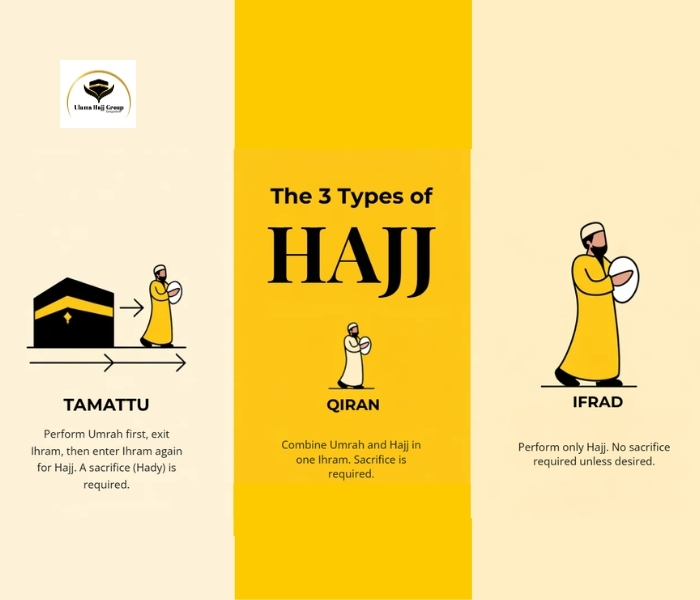
Perform Umrah first, exit Ihram, then enter Ihram again for Hajj. A sacrifice (Hady) is required.
Combine Umrah and Hajj in one Ihram. Sacrifice is required.
Perform only Hajj. No sacrifice required unless desired.
Perform Ghusl (full bath).
For men: Wear two unstitched white cloths (izar lower, rida upper). No underwear, socks, or head covering.
For women: Wear modest loose clothing; no face veil or gloves.
Labbayk Allahumma Labbayk. Labbayka La Shareeka Laka Labbayk. Innal Hamda Wan Ni’mata Laka Wal Mulk. La Shareeka Lak.
No perfume, sewn clothes (men), cutting hair/nails, hunting, marital relations, arguing.
Women should avoid niqab/face covering that touches the face.
Enter Ihram at Miqat and recite Talbiyah.
Tawaf: Upon reaching Masjid al-Haram, perform 7 circuits around the Kaaba (start at Black Stone). Men uncover right shoulder (Idtiba’). Pray 2 rak’at behind Maqam Ibrahim.
Sa’i: Walk 7 times between Safa and Marwah hills.
Halq/Taqsir: Shave head (men) or trim hair. Women trim a fingertip’s length.
Exit Ihram — you may now wear normal clothes and use perfume.
Perform this Umrah during the months of Hajj (Shawwal to Dhul-Hijjah).
5. Main Hajj Rituals (Day-by-Day Guide – Tamattu’)
Hajj rituals span from the 8th to 12th/13th of Dhul-Hijjah. For 2026 (1447 AH), these fall approximately late May (exact dates confirmed by moon sighting).
8th Dhul-Hijjah (Yawm at-Tarwiyah)
Re-enter Ihram in Makkah (intention for Hajj).
Proceed to Mina and spend the night in tents. Pray Zuhr, Asr, Maghrib, Isha combined/shortened.
9th Dhul-Hijjah (Day of Arafah – Most Important Day)
Move to the Plain of Arafat after Fajr.
Stand in supplication (Wuquf) from after Zuhr until sunset — this is the core of Hajj.
Combine Zuhr + Asr prayers.
After sunset, move to Muzdalifah. Pray Maghrib + Isha combined. Collect 49 or 70 pebbles. Spend the night under the open sky.
10th Dhul-Hijjah (Eid al-Adha)
Before sunrise, return to Mina.
Stone the Big Jamarah (Jamrat al-Aqabah) with 7 pebbles.
Perform sacrifice (Hady) — arrange in advance via your package.
Shave/trim hair.
Go to Makkah for Tawaf al-Ifadah (7 circuits) + Sa’i (if not done after Umrah).
Return to Mina for the night.
11th–13th Dhul-Hijjah (Days of Tashriq)
Stone all three Jamarat (7 pebbles each) after Zuhr each day.
Spend nights in Mina.
On the 12th (or 13th if you stay), complete stoning and return to Makkah.
Farewell Tawaf (Tawaf al-Wida’) Perform 7 circuits around the Kaaba before leaving Makkah. This is obligatory for non-residents.
Women-Specific Notes Women follow the same rites but have some relaxations (e.g., no Idtiba’, can wear stitched clothes). Menstruating women can do most rites except Tawaf (they perform it later when pure).
Recite abundantly:
Talbiyah throughout (until stoning on 10th).
During Tawaf: Duas for forgiveness, Paradise, protection from Hell.
At Arafah: The best supplication is any sincere dua — ask for everything.
Key dua example: “Rabbana atina fid-dunya hasanatan wa fil-akhirati hasanatan wa qina ‘adhaban-nar.”
Carry a dua book or use reliable apps. Focus on dhikr, Quran, and personal prayers.
What Invalidates Hajj? Missing Wuquf at Arafah or having relations before the 10th generally invalidates it (consult a scholar for specifics).
Common Mistakes to Avoid
Not learning rituals properly beforehand.
Incorrect Ihram clothing or violations.
Losing temper in crowds.
Getting separated from group — use meeting points and apps.
Delaying stoning or forgetting pebbles.
Touching or kissing Black Stone forcefully — point from afar if crowded.
Compensations Minor mistakes may require feeding the poor (Fidya) or sacrificing a sheep (Dam).
Emergencies Seek medical help immediately. Saudi authorities have excellent facilities.
After completing Hajj:
A true Hajji/Hajjah is known by their improved character.
Yes, after the obligatory one.
Rites can sometimes be delegated or compensated.
May Allah bless you with a safe, valid Hajj with barakah. You can ask questions or seek clarification on any of the parts. Begin to prepare, today–the most effective preparation is good will and understanding.